
Sprockets and Roller Chains Machined to Drawing
Drive, conveyor and duplex sprockets from 9 to 80 teeth, pitch 6.35 to 50.8 mm, induction-hardened flanks HRC 45–55, bores and keyways machined to the drawing.
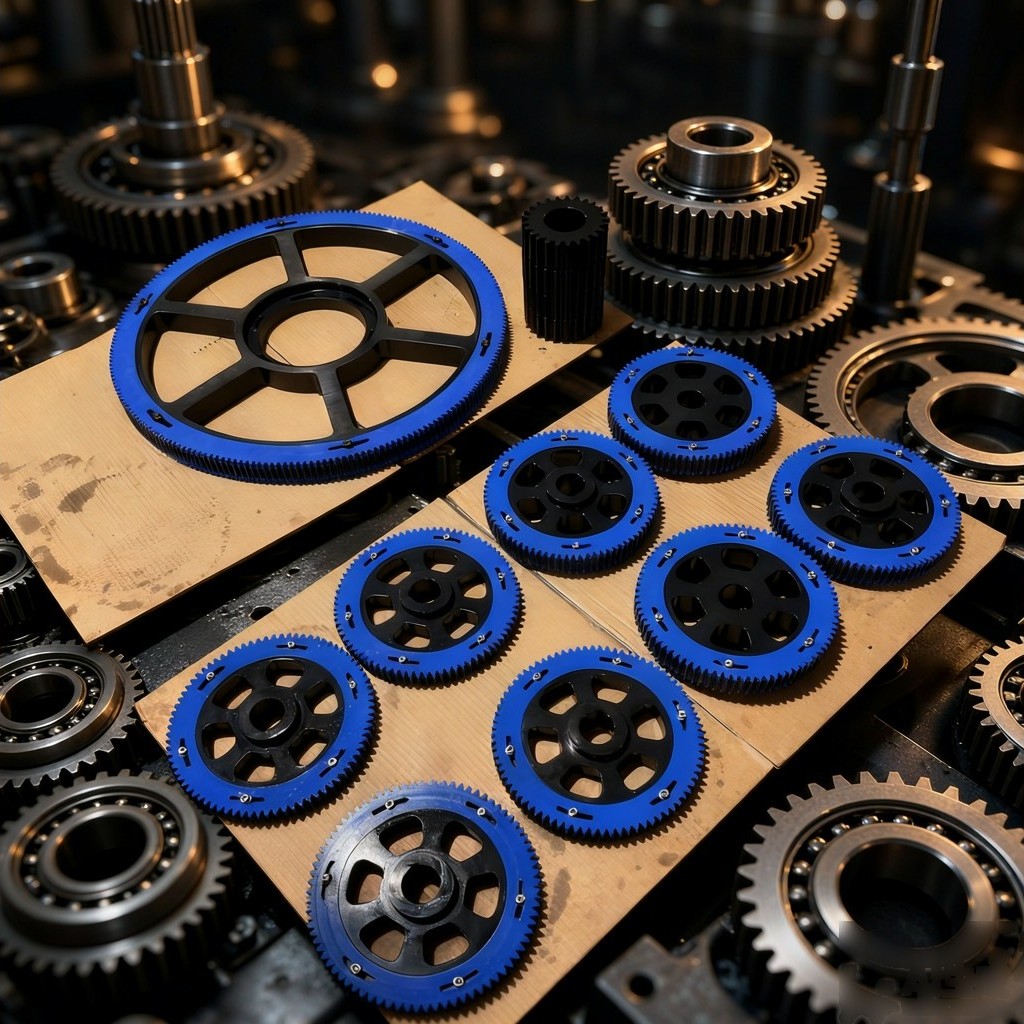
A chain drive is only as good as the sprocket that carries it. Tooth form decides how the roller seats, pitch accuracy decides whether the chain wears evenly, and the bore and keyway decide whether the sprocket runs true on the shaft at all.
PinyiGear machines drive, conveyor, duplex and custom sprockets — 9 to 80 teeth, pitch 6.35 to 50.8 mm — with induction-hardened flanks and bores cut to the drawing. Matching A and B series roller chains can ship with the order.
Choosing the sprocket type
| Type | Construction | Typical use |
|---|---|---|
| Drive sprocket | Single strand, standard roller chain | General transmission, reducers, machine drives |
| Conveyor sprocket | Double-pitch or flat-top chain form | Conveying machinery, where the chain carries product |
| Duplex / triplex | Two or three strands on one hub | High power in a narrow width |
| Custom sprocket | Agricultural, special profiles, non-standard bores | Equipment where the chain is non-standard |
The first question is what the chain has to do. A drive sprocket transmits power and the priority is tooth accuracy and wear life; a conveyor sprocket carries load at low speed and the priority is strength and resistance to abrasive material; a multi-strand sprocket exists because the power will not fit through one chain.
Working ranges
| Item | Range |
|---|---|
| Teeth | 9 to 80 |
| Pitch | 6.35 to 50.8 mm |
| Standards | ANSI 40–200; DIN/ISO 08A–20B |
| Tooth profile | Standard roller-chain profile, A and B series |
| Materials | 45#, 40Cr, S45C, SCM440, QT600-3 ductile iron, stainless 304/316, engineering nylon |
| Heat treatment | Tooth flanks induction hardened HRC 45–55 |
| Accuracy | GB class 6–8 |
| Bore | Machined to drawing, including keyway and set-screw holes |
Two parameters decide most of the geometry. Tooth count sets the wrap angle and the chordal action — fewer teeth mean a larger speed variation per tooth and more wear on the chain. Pitch sets the chain size and the load a strand can carry. Everything else follows from the chain chosen.
Standards and interchangeability
ANSI and DIN/ISO chains are dimensionally similar but not identical, and a sprocket cut for one will not run correctly on the other. The usual series:
- ANSI: 40, 50, 60, 80, 100, 120, 140, 160, 180, 200
- DIN / ISO: 08A, 08B, 10A, 10B, 12A, 12B, 16A, 16B, 20A, 20B
A and B series differ in roller width and, at some sizes, roller diameter — an 08B chain does not interchange with an 08A chain. When a sprocket is supplied without a stated standard, the first thing that has to be settled is which chain it will run.
Roller chains
Simplex, duplex and multiplex chains in both A and B series, matched to the sprocket order.
| Standard | Chain | Pitch p (mm) | Roller dia. d₁ (mm) | Inner width b₁ (mm) |
|---|---|---|---|---|
| DIN/ISO | 08B-1 | 12.7 | 8.51 | 7.75 |
| ANSI/ISO | 16A-1 | 25.4 | 15.88 | 15.88 |
Chain and sprocket are a pair in the same sense that a gear and pinion are. Buying them together removes the argument about which side caused the wear pattern.
Machining
| Operation | Accuracy | Applies to |
|---|---|---|
| Hobbing | GB 6–8 | Standard tooth forms, production quantities |
| CNC gear milling | GB 6–8 | Larger sprockets, non-standard tooth forms |
| Shaping | GB 7–8 | Where the tooth form cannot be hobbed |
| CNC turning | Per drawing | Bores, faces, hubs, keyways |
| Wire EDM | Per drawing | Hardened parts, special apertures |
Sequence: tooth cutting first, then boring and facing, then induction hardening of the flanks, then the keyway and set-screw holes. That order matters — cutting the keyway before hardening means the keyway distorts, and hardening after boring means the bore has to be finished again.
Inspection
- Tooth profile and pitch — measured against the chain standard, not just against a drawing dimension
- Runout between the bore and the pitch circle, which is what decides whether the chain runs true
- Bore and keyway — size, position, and fit against the shaft
- Hardness at the tooth flank
- Concentricity between hub and tooth ring on welded or bolted constructions
A sprocket that measures correct on tooth count and pitch but has runout between bore and teeth will load one side of the chain and wear it out early. Runout is the number worth asking for.
Where they are used
General drive systems, conveying machinery, packaging and filling lines, agricultural equipment, high-power drives where a multi-strand chain replaces a gearbox, and replacement sprockets for equipment whose original part is no longer supplied.
Related transmission parts
Racks, sprockets, timing pulleys and couplings can be supplied together, which matters when a machine has several drive types and the customer would rather not coordinate four suppliers.
| Part | Types |
|---|---|
| Couplings | Flexible, rigid, diaphragm |
| Timing pulleys | HTD, STD, GT, XL, L, H series |
| Gear racks | Straight and helical, ground to DIN 6h25 where required |
What to send
- Sprocket drawing (PDF, DXF, STEP, DWG), or chain standard plus tooth count
- The chain model, if the sprocket must match an existing chain
- Bore, keyway and set-screw details
- Material and heat treatment if fixed
- Quantity and whether the order is a prototype, a first batch or repeat production
Send a sprocket drawing for quotation
FAQ
Can you cut a sprocket to match a chain I already have? Yes — send the chain model or a short sample. The tooth form has to match the roller diameter and pitch of that specific chain, so the chain is the reference, not the drawing alone.
Which standard should I specify? Whichever chain you will run. ANSI and DIN/ISO differ in roller width and sometimes roller diameter, and a sprocket cut for one will not run correctly on the other.
Is hardening necessary? For drive duty at any real load, yes. Induction-hardened flanks resist the wear that opens the tooth form and lets the chain ride higher, which is the beginning of the end for a chain drive.
Can you supply the chain as well? Yes, simplex, duplex and multiplex in A and B series, matched to the sprocket.
What runout can you hold between bore and teeth? It is specified per drawing; what matters is that it is stated. Runout is what decides whether the chain loads evenly across its width.
Related pages
Related reading
- TechnicalSprockets vs Timing Pulleys: Selection and Accuracy
- ProductSpur and Helical Gears Machined to Customer Drawing
- ProductBevel Gears — Straight and Spiral for Right-Angle Drives
- TechnicalChoosing Between Soft and Hard Gear Tooth Flanks: How the 350 HBW Threshold Drives Material, Heat Treatment and Process Routing