
Custom Gears Machined to Your Drawing
Non-standard modules and special tooth profiles machined to the drawing — the enquiry is reviewed by an engineer before any price is quoted, so the process route matches the part.
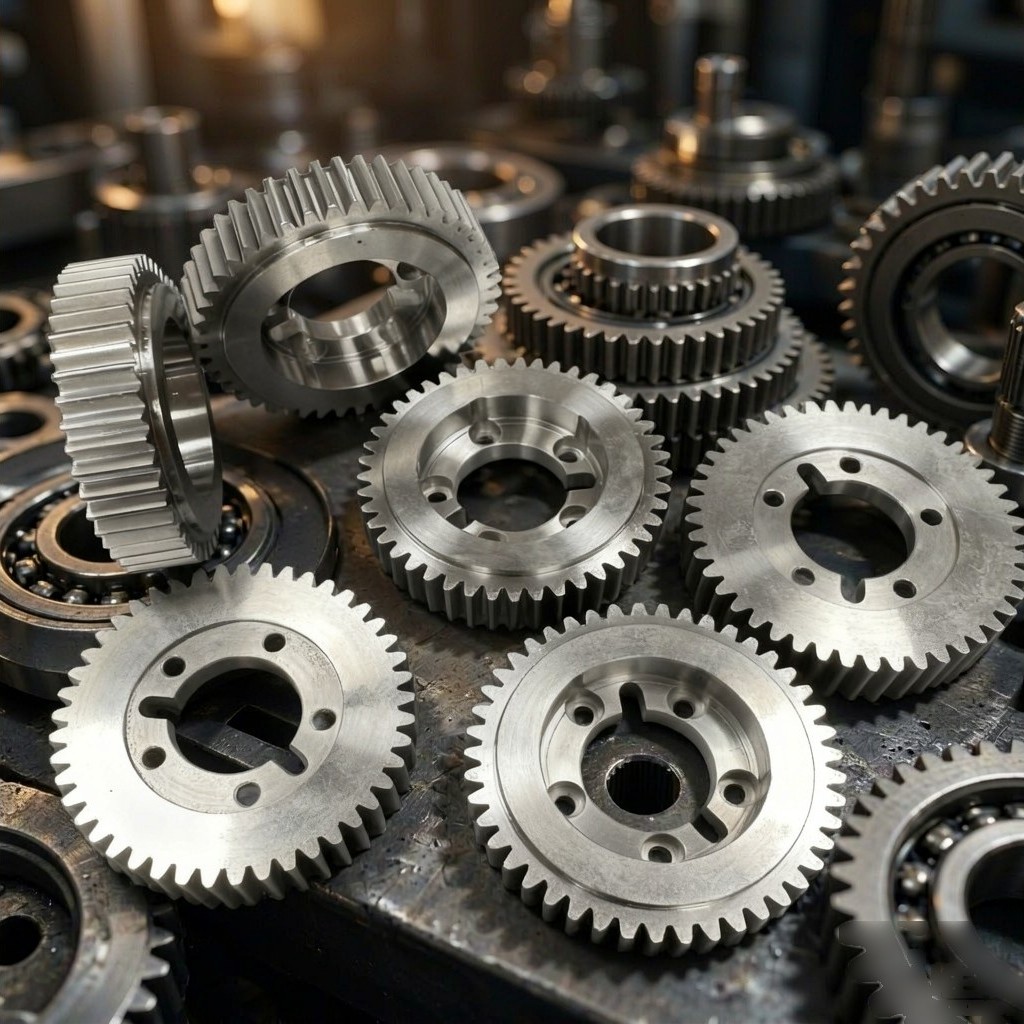
Most custom gear work does not start with a catalogue number. It starts with a drawing from a machine builder, a sample from a gearbox that failed, or a part number from an overseas supplier that no longer answers. None of those come with a standard price, and quoting them as if they were standard parts is how custom gear enquiries go wrong.
PinyiGear makes gears to the drawing. An engineer reads the enquiry and the process route before a price is quoted, so the quote reflects the tooth, the material, the heat treatment and the inspection the part actually needs.
What “custom” covers here
- Non-standard modules — outside the standard series, or an odd module chosen by the original design
- Special tooth profiles — cycloidal, circular arc, or a profile that exists only on the customer’s drawing
- Modified standard gears — standard module with a non-standard face width, hub, bore or mounting feature
- Spline bores and integrated drive features — the gear and its mounting made as one part
- Reverse engineering — a sample or a worn part measured and turned into a dimensioned drawing for confirmation
- Replacement of imported gears — the same function, made locally, without the import lead time
The engineering review
The review is not a formality. For a custom gear, four questions decide whether the part can be made as drawn and what it will cost:
Is the tooth geometry complete? Module, pressure angle, helix angle, tooth thickness, profile shift, tip and root geometry. A drawing that says “M2, 40 teeth” and nothing else is a starting point, not a specification.
Does the material and heat treatment fit the duty? A gear drawing that calls for a case-hardened alloy in a light-duty application costs more than it needs to; a gear cut from mild steel in a shock-loaded application will fail early. If the drawing is open, the duty decides.
Can the part be inspected as drawn? Tolerances that cannot be measured are not tolerances. If the drawing calls for a runout between two features, the datum scheme has to make that measurable.
Is there a mating part? Gears work in pairs. Centre distance, backlash and contact pattern are properties of the pair, so a gear quoted alone may fit the drawing and still not mesh.
Manufacturing scope
| Item | Range |
|---|---|
| Module | M0.3 to M20, standard or non-standard |
| Outer diameter | According to the drawing and the machine envelope |
| Accuracy | As specified — GB 3 to 9 grade, or DIN/ISO/AGMA equivalent where the drawing names one |
| Standards | Customer drawing; reverse-engineered parts dimensioned to GB, DIN, ISO or AGMA |
| Materials | Alloy steel, carbon steel, stainless steel, copper alloy, aluminium alloy, engineering plastics |
| Custom forms | Non-standard module, special profile, spline bore, integrated hub or drive feature |
| Heat treatment | Quench and temper, carburising, induction hardening, nitriding |
Reverse engineering
Worn or broken gears are often the only reference available — the original drawing is gone, the machine is old, the supplier has stopped supporting it. The part can be measured and rebuilt, but the process has limits worth stating:
- Tooth geometry can be measured on a gear measuring centre, including profile and lead, and expressed as a dimensioned drawing.
- Material can be identified by spectrum analysis, and hardness measured, so the replacement can be specified to match or improve.
- Wear cannot be measured. A worn tooth has lost material, so the measured profile is the worn profile, not the original. Where wear is significant, the geometry is reconstructed from the unworn portion and confirmed with the customer.
- The mating part decides the fit. A replacement gear meshing with a worn pinion will not run quietly no matter how accurate the new part is.
The output of reverse engineering is a drawing, sent for confirmation before production. That confirmation step is what stops a measurement error from becoming a batch of scrap.
Process route
- Enquiry review — drawing or sample, duty, quantity, mating parts.
- Feasibility and process decision — cutting method, heat treatment, grinding, inspection plan.
- Quotation — price, lead time, and any open points stated explicitly.
- Sample or first article — where the part is new or the drawing was reconstructed.
- Production — with in-process checks at the operations that can hide a problem.
- Final inspection — report against the drawing, with measured values.
- Repeat orders — the same route, drawing and inspection plan reused, so the second batch matches the first.
Where custom gears appear
Equipment built to a non-standard specification, drive systems running under unusual conditions — high temperature, corrosive atmosphere, food-grade cleaning — worn gears needing replacement, and machines imported years ago whose spare parts now take months to arrive.
What to send
- Drawing (PDF, DXF, STEP, DWG, IGES), or a sample with dimensions
- Mating gear or pinion drawing, if the pair matters
- Duty: torque, speed, environment, expected life
- Material and heat treatment if fixed; if open, state the duty
- Quantity and whether the order is a prototype, a first batch or repeat production
Send a custom gear drawing for quotation
FAQ
Can you make a gear from a sample without a drawing? Yes. The sample is measured, a drawing is produced, and the drawing is confirmed with the customer before production. Where the sample is worn, the geometry is reconstructed rather than copied.
What if the module is non-standard? It is cut to the drawing. Non-standard modules are common on imported and older equipment; what matters is that the value is dimensioned rather than described.
Can you match the hardness of an original part? Yes — the original can be tested and the replacement specified to match, or improved where the original failed. Hardness alone does not define a heat treatment, so the case depth and core properties are specified too where they matter.
How is a custom gear priced? By the operations the drawing requires: tooth cutting method, material, heat treatment, grinding, inspection. Two gears of the same size can differ several times in price depending on those four.
Do you make the mating pinion as well? Yes, and it is the better way to buy a pair. Backlash and contact pattern are set between the two parts.